Most "build vs. buy" debates end the same way. A team scopes a six-month editor project, ships an MVP in nine, then spends the next two years fixing font rendering on Safari, transparency edge cases in PNG export, and the undo stack that breaks whenever a user pastes from Figma. The work is never done, because an image editor bundles about forty separate features.
This post is the case for skipping that road. Not because building is impossible, but because the parts you don't see going in are the ones that sink the timeline.
What you're actually building
A serious image editor needs canvas rendering, text layout with kerning and font fallbacks, vector shapes, image filters, layers and grouping, alignment guides, undo/redo, copy/paste from external sources, multi-page support, drag-and-drop assets, template loading, JSON serialization, and pixel-perfect export to PNG, JPG, PDF, GIF, and MP4, at the resolution your users ask for, on the browser they happen to use.
That's before AI features, before video, before cloud rendering for batch jobs, and before the part where you load a 50 MB design with 200 elements and it still has to feel snappy.
A two-engineer team can fake this in a quarter. Making it production-grade, meaning users don't email support when their text wraps wrong on Firefox, takes years. We know because Polotno SDK is what we ship full-time, and we still find edge cases.
“Polotno allowing companies build Canva-like experiences for a fraction of a cost you'd expect”

Moshe Gorin
CEO @ KosherGraphics
Image editing API – frontend demo
Time
Polotno integrates in days. A working editor, full toolbar, templates, custom fonts, your branding, is one React component and an API key. Most customers ship a private build to staging in the first week.
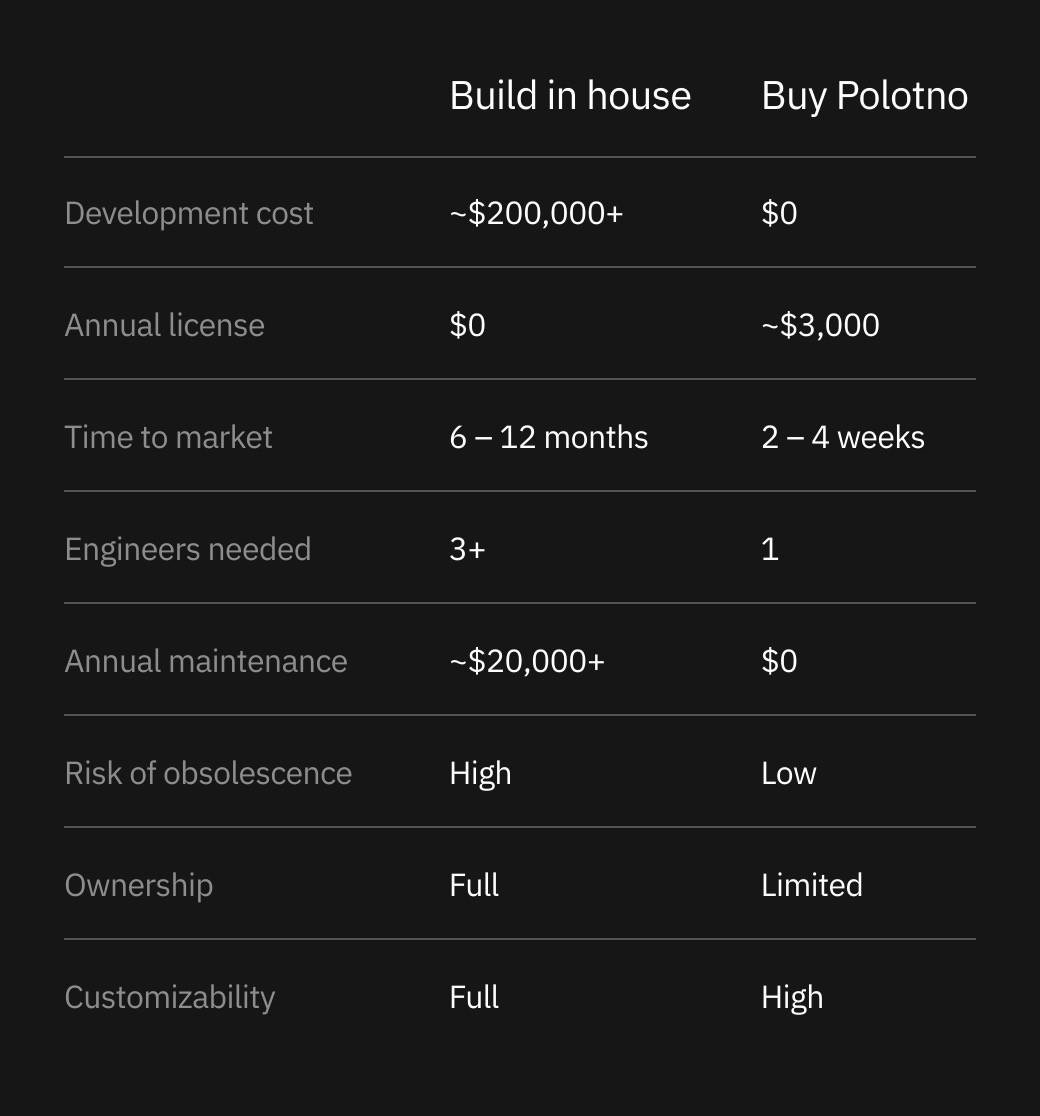
The build-it-yourself number depends on scope, but a useful benchmark: teams that try the Konva.js or Fabric.js route alone (Polotno itself is built on Konva.js) typically spend 9–18 months getting to a feature set that compares to what ships out of the box here. That gap is engineers you're paying instead of putting on your actual product.
Cost
Polotno is one commercial license, quoted on scope and volume: from low hundreds for a small rollout to 20-30k+ for an enterprise one. Self-hosted editing and rendering are unlimited under fair use, with no per-seat or per-render fees.
Build in-house and you're committing two engineers for a year minimum, plus design, plus a long tail of maintenance you'll absorb forever. At fully-loaded US rates, that's $400K+ before you ship, to rebuild a tool that already exists.
Larger contracts can cover version pinning, custom SLAs, and a source-code license.
What expertise actually means
The deep knowledge isn't "I know JavaScript." It's "I know why canvas.toDataURL() produces a blank image when the source uses a font that hasn't loaded yet" and "I know how to keep a 4K export from OOM-ing on a Chromebook."
“The integration process was relatively straightforward and we've got good help from Polotno”

Heikki Rusama
Founder @ Freeed
Risk: scaling and rendering
Client-side rendering is fine until a customer wants to generate 10,000 personalized banners overnight. Then you need server-side rendering: a queue, a headless browser fleet, a font cache, retry logic, and an export pipeline that doesn't fall over when one document has a corrupt SVG.
Polotno gives you three rendering modes from the same JSON schema:
- Client-side: runs in the user's browser, zero backend, instant export.
- Self-hosted: Polotno's Node.js renderer inside your infrastructure, for private data and high-volume pipelines.
- Cloud Render API: managed by us, billed per render, no infra to maintain.
Same designs render identically across all three. Switching between them is a matter of where you call the renderer, not of changing the design.
Focus
The real cost of building is the team that stops working on what differentiates you. If your product is an AI marketing platform, every week your engineers spend on font kerning is a week competitors spend on AI.
“It was a very copy paste kind of thing that we initially did. It was up and running pretty quickly… within 1 or 2 weeks”

Aakash Kerawat
Co-Founder @ Predis
Where Polotno SDK earns its keep
A few patterns customers actually ship:
Template-driven content at scale. Marketing platforms feed product feeds, campaign data, or user variables into Polotno templates and render thousands of branded creatives via the Cloud Render API. Predis and AdPerfect use this pattern to power AI-generated social posts.
End-user editors inside SaaS. Real estate platforms like Aryeo embed the editor so agents customize flyers and postcards without leaving the app. White-label theming, custom asset libraries, and per-tenant template lists are configured at runtime, not forked.
Print-on-demand. Integrations with Lulu, Mixam, Peecho, and Packhelp push print-ready PDFs straight to a printer's API, bleed, CMYK, and resolution settings handled in the export config.
Programmatic asset generation. Certificates, event tickets, dynamic OG images, personalized email creatives, anywhere you'd otherwise be cobbling together node-canvas with custom font loading and SVG hacks.
Where building in-house actually makes sense
Two cases:
- The editor is your product. If you're building Figma, you should build Figma.
- Your design surface is one or two specific operations: a single crop tool, a watermark stamp, a one-off filter. A full SDK is overkill. A few hundred lines of canvas code is the right answer.
Everything else, anywhere users compose multi-element designs, anywhere you'll eventually want templates, anywhere export quality matters, buy the SDK. The math doesn't get better the more you investigate it.
Try it without a credit card
Polotno includes a 30-day free trial on a private dev server. No card, full feature set, our public support SLA. You upgrade when you go to production or when 30 days are up, whichever comes first.